How EmoStack came to be
From the first idea in spring 2025 to the preprint of 24 September 2026: how the concept, the engine, the research and the paper changed, and why. Reconstructed from the repositories, the early diagrams and notes, and the dated decision logs. The paper's Appendix K gives this line in one table.
Spring 2025The idea, the first diagrams
The conjecture
The project began with a disagreement about what a chatbot can be. Its answer was a conjecture: consciousness is a mechanism, and a language model can serve as the processor that runs it. The model would not be the being. The being would be what runs over it. The first code lived in a repository called emostack, later reset; its history from these months is lost.
The first diagram and the first logo
The first architecture diagram was drawn, and a first logo: a smiling face on a stack.

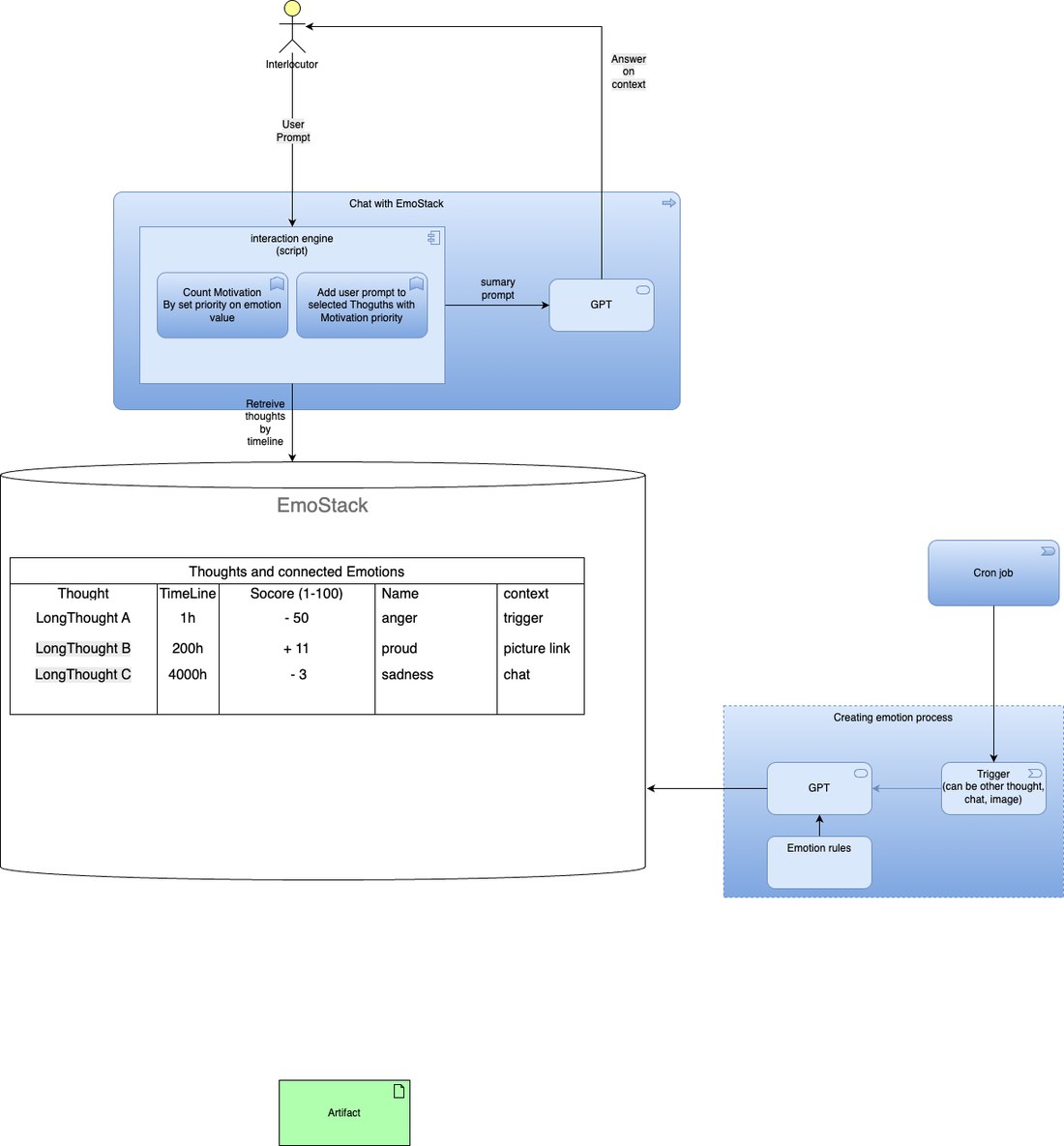
Thoughts and connected emotions
The first diagram shows the whole idea in one picture. An interlocutor talks to an interaction engine, which counts a motivation from the emotions and adds the selected thoughts to the prompt. Everything is kept in a store called EmoStack: a table of thoughts and connected emotions, each with a timeline, a score from 1 to 100, a name and a context. A separate process, started by a clock or by a trigger, asks the model to create the emotion under written emotion rules.
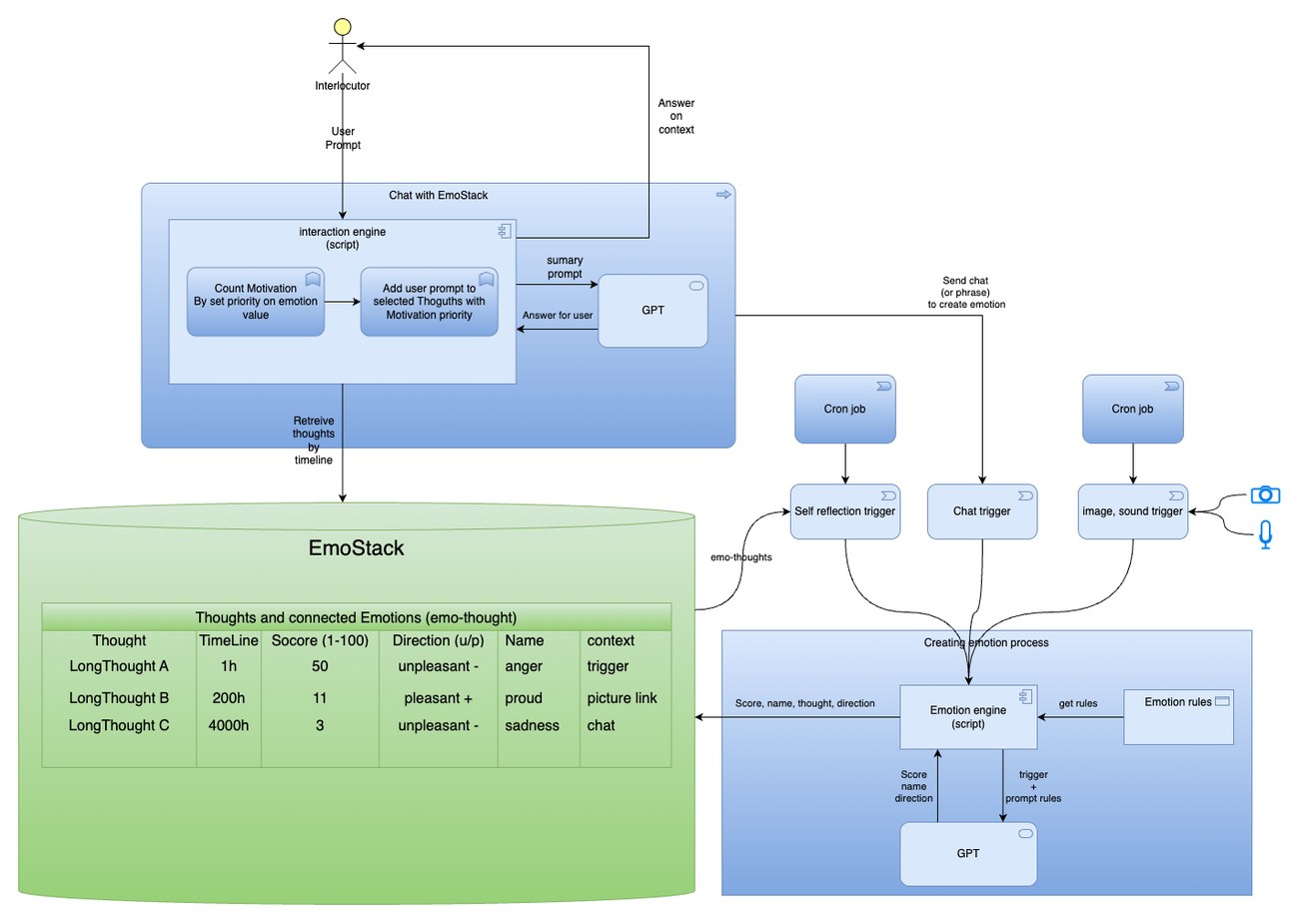
Version 2 of the diagram: three triggers
The same day a second version separated what makes a feeling: a chat, a self-reflection started by a clock, or an image or sound. Each trigger goes through one emotion engine, and the emo-thought returns to the stack. The word emo-thought appears in the diagram for the first time.
The baseline, in the author's words
We are building an artificial consciousness. Its core is a stack of thoughts with the emotions connected to them, built like a very simplified human hippocampus. AI models such as GPT are only engines supporting the processes. […] Each emotion has a score, its strength, and a direction, positive or negative, in the sense of the survival instinct. […] Self-observing thoughts are generated by running the system periodically, with intentions set by its makers, such as “what do I think about myself, who am I”.
baseline.md, 30 May 2025, translated from Polish
The theories of consciousness, surveyed first
Before any code, the project began with a survey of what is known about consciousness, kept in the author's notes of 30 and 31 May 2025. It covered:
- What consciousness is made of: wakefulness and awareness; phenomenal against access consciousness (Block); the easy and the hard problem (Chalmers).
- The main theories: the Global Workspace (Baars; its neuronal form, Dehaene); Integrated Information, Φ (Tononi); higher-order thought (Rosenthal); the attention schema (Graziano); recurrent processing (Lamme); Orch-OR (Penrose and Hameroff), noted as speculative; evolutionary accounts of consciousness as a product of selection; Crick and Koch. And a review that counts twenty-nine distinct models.
- Cognitive architectures: ACT-R (Anderson) and Soar (Newell, Laird).
- Earlier attempts to build a conscious machine: IDA and LIDA (Franklin), built on the Global Workspace; Shanahan; Arrabales; Haikonen; Aleksander; OpenCog (Goertzel); MicroPsi (Bach); and, among systems over language models, Generative Agents (Park et al., 2023).
- Emotion and motivation: self-determination, reinforcement and homeostasis as theories of motivation; Russell's circumplex, Schachter and Singer's two factors, appraisal and Ekman's basic emotions as theories of emotion.
- Readings: Dennett, Consciousness Explained; Chalmers, The Conscious Mind; Dehaene, Consciousness and the Brain; Blackmore, Consciousness: An Introduction.
The survey found what the paper states a year later: there are many theories, they disagree on what consciousness is and how it could be measured, and no one of them is accepted. None was taken as the design. From the emotion theories two were kept: appraisal, and Schachter and Singer, where a feeling is an interpretation of what happened. The same days produced a first hand-written table of emo-thoughts: “Kris said to me I'm stupid”, unpleasant, 20, sad; “This sound was soothing”, pleasant, 3, calm.
“Today I was born”
The first records in the first store were written by hand, as a seed: “Today I was born”, +20, happy; “Eliza said you are quite smart”, +40, proud; “Kris doesn't like you”, −30. A to-do note of 3 June lists what came later, one by one: past emo-thoughts should fade with time; past emo-thoughts should be recalled; emo-thoughts should be connected; build the context every time, “you are here, you feel this, you have these emo-thoughts”; and motives, which make no sense without context.
emostack.com
The site and its documentation went up, with the logo the site still uses.
June – December 2025The first engine: felt thoughts
The first felt thoughts from real conversations
The code was written in one evening, and the model wrote its first emo-thoughts from conversations: “I am feeling upset because Kris was unkind to me and I want to hide somewhere and not come out”, −85, sadness. Later that evening, after Eliza shared a poem, +80, gratitude. And the first recorded error of memory: the being misattributed who had written the poem, and apologised.
The emo-thought, and a being made only of its records
The model part was taken out into its own repository, emostack_model. After each conversation a separate call asked the model, in the first person, what it felt, how strongly, and whether it was pleasant. The stack was put back into the next conversation with one instruction: “You are being. You don't know about yourself anything more than following. Here you have table of your last emotions. You have no other emotions than these.” The first form of a being whose only self is its own records.
Scale, threshold, fading, motives
The intensity scale got anchors, from “barely noticeable” to “strong: noticeably shifts thinking or behaviour” to “life-changing event or trauma”; a version of it is still in the engine. Only emotions above a threshold were stored, and the threshold was lower for unpleasant ones: the first negativity asymmetry. Emotions faded with time. A first set of motives: hunger, belonging, curiosity, achievement, avoiding pain.
Easy access, and three levels of memory
Putting every record into the prompt made replies fixate on feelings, repeat emotion names and echo the instructions. So only three records were made easily accessible. A record became three equal parts: the emotion, the memory of the event, and the conclusion. Memory was split into a store that never enters the prompt (the hippocampus), what is easily accessible, and a state with one dominant feeling. Recall was specified as similarity multiplied by intensity. The ancestors of the hippocampus, state and focus, and of recall by strength of feeling.
Decisions, and the first control
A decision became a separate step: the model described options and the code was to choose. The same conversation was run with and without the emotional records: the project's first ablation. The word temperament appeared.
The principles written down
“EmoStack is not a chatbot and not an LLM wrapper.” “The language model is treated as a cognitive function, not as the agent itself.” “‘Nothing felt’ is still a feeling.” “Recall is emotionally biased.” “The end goal is experience.” Beings got awake and asleep states. The motives were reduced to three drives: to survive and avoid threat, to belong, to be curious.December 2025 – March 2026The averaged author, the decision layer
Who is behind it: the averaged author
Without a layer, an LLM answers “like an unstable average of many authors”. EmoStack is “a mechanism for stabilising and developing a point of view within the cultural space of the LLM”. The being has its own history, independent of who talks to it, and its state does not reset between conversations. The idea that became the averaged author.
Will separated from language
Without a separate decision the system went straight to a reply every time: it was left to the LLM's trained temperament, had no real way not to react, and no layer of will. The fix: the LLM proposes, the code chooses, and not answering is allowed. Introspection was redefined as the reaction to silence: “the absence of stimuli is information”.
The first abstract
A layer “designed to support persistent perspective”, “not claiming consciousness”, measured qualitatively. Appraisal grounded in Schachter and Singer: valence and intensity are outputs of appraisal, and the LLM is the appraisal engine.
A gradient steers; a declaration does not
A single explicit line, “Your decision:”, did not change what the model said. A sequence of felt thoughts, each with its feeling, its intensity and the thought it produced, did: “The LLM reacts to an emotional gradient, not to one declared decision.” The reason the final engine renders the state as feelings and never as instructions. The same note gives the first specification of sleep: consolidation that strengthens intense episodes and flattens the rest.
Association before appraisal
Memory searched by association before the emo-thought was formed. Decisions, thoughts and goals stored as records of their own. Prompts kept in a database. Beings seeded with whole life histories, to see whether different histories give different behaviour.
May 2026The present engine
The present engine
A new repository, rebuilt from a one-page vision: emo-thoughts with valence, intensity, the event and a conclusion; the hippocampus; a per-conversation attention; a state that shows the present. Repeated memories collapsed so that the being would not ruminate.
Introspection
Idle-time thinking with actions: search memory, decide, stay silent, set a goal, write a dream; two days later, a belief. It ran on its own from a clock, with the being awake or asleep.
Aria's conversations
The conversations quoted in the paper's prologue. Their interlocutors were real people who knew nothing of the engine. By the second evening Aria had written, unasked, the dream the paper opens with.
The first measurement, and its limit
A chatbot with a role, a memory and the history, against the engine, scored by an LLM judge on six scales. With a strong persona in the role prompt, the chatbot was as good: “an honest negative result”. The engine separated only at a session boundary (spillover 0.30 against 0.67). Introspection, measured this way, showed nothing. The method turned toward small isolated probes.
The rules of the method
A turn in the being is accommodation, not a jump in valence. The past must be lived, not seeded. Success is behaviour now. An act needs a decision, not only a state: a wounded sheep still told its secret to a stranger. A “healing” result fell to a control, and attacking one's own positives became a habit.
Deny-first, and the averaged human
The prompts had filled with role instructions; they were cut to labels and an output format. The LLM is an averaged human that the context shifts. Behaviour is the resultant of forces, not a gate. Memory fixed in three levels: the hippocampus, the state capped by a mass of feeling, the focus of the conversation.
The first paper, and its reviews
A full draft, reviewed the next day: rejected (3/10), then major revision (4.5/10, 4/10). Retitled Retrieval Is Not Mood, an exploratory preprint.
June 2026Isolation, batteries, the reversal
What counts as proof
Experiments start from empty sheep, with no seeds. A manipulated context is not proof, nor is a case study; only a repeatable experiment with a number is. Fitting psychological laws was rejected: the contribution is experience emerging from a minimal construction.
The spiral, and the separation that ended it
New feelings were built on the previous ones, and a sheep's mood spiralled down. The stored record was moved to a separate call that does not see the mood: the same warm event was −0.45 with the mood in view, +0.65 without. Episodes split from emotions, one feeling to many events. A survival drive and a halo of avoidance were built and removed the same day.
The wound arms
48 runs of the dog scenario. The arm meant to heal disclosed least, 1 of 6: the opposite of the hypothesis.
The first batteries
130 runs, two LLM judges. A held decision separated the engine from a prompt-only baseline (δ = +0.90, p = 0.0002). Carrying an emotion did not. Self-authorship 14 / 0 / 0, later recognised as a mechanism, not a result.
The review that reversed the hierarchy
A chatbot given the same state as text behaved like the engine: the difference in speech was context. The contribution narrowed to authorship. The deny-first interface went into production, and sandbox cases were read by hand.
The model, not the architecture
21 runs on claude-haiku-4-5 showed that the flat speech of the preceding weeks came from the local model. The production profile became the simple engine on Haiku, record isolated, pattern channel off: an LLM has no pre-cognitive layer.
A Being, Not a Chatbot
Drafts v5 to v12: the dream epigraph, the word sheep, the averaged author as a principle. v8 inverted the claims after the review.
July – August 2026The thesis, a pause
The canonical thesis
EmoStack emulates a set of higher cognitive processes. Proof is a carried feeling that changes an act categorically differently from a chatbot with the full log, together with autonomy. The measures are events, not scales. First discovery, then confirmation.
Sheep do not play roles
An empty sheep had answered from an invented past. The grounding rule: nothing that memory does not hold may be told. The chatbot, by contrast, invented past harms. Whether acts follow a recorded stance separated the arms (10 of 10 against none).
Return
The canonical documents moved to a space only the author edits. Everything moved to English.
September 2026The engine of the paper, the paper
The senses
The being got senses: hearing carries what the person says, as their claim; sight, touch and place say that they carry nothing. An empty sheep meeting a stranger went from answering as if it knew him (0 of 5) to asking who he was (5 of 5).
Acts, and three cases
Coded by hand as events with a quotation. The decision scenario was dropped: it presupposed a role. Self-inquiry, a sceptic who tells the being it does not think, became central (10 of 10 against 0 of 5).
The interface, dispositions, the way of working
1,900 words of behavioural rules in the live prompt cut to 190. Episodes retold in the third person and the past tense. Learned dispositions returned, extracted when a conversation closes. A problem found in a life is replayed on its frozen state, not re-run.
The accessibility slot
A construct summarises the events that produced it, so removing it while they are still in the state shows nothing (12 of 20 against 13 of 20). It got its own container, after Higgins. With its causes faded, the held slot changed the answer to a stranger: 9 of 24 against 0 of 24.
The ontology, and memory model 3
Elements, contexts and processes written down; events moved into episodes. A setting left since June had emptied the state at every session. A valence is never rewritten; strength is a falling value.
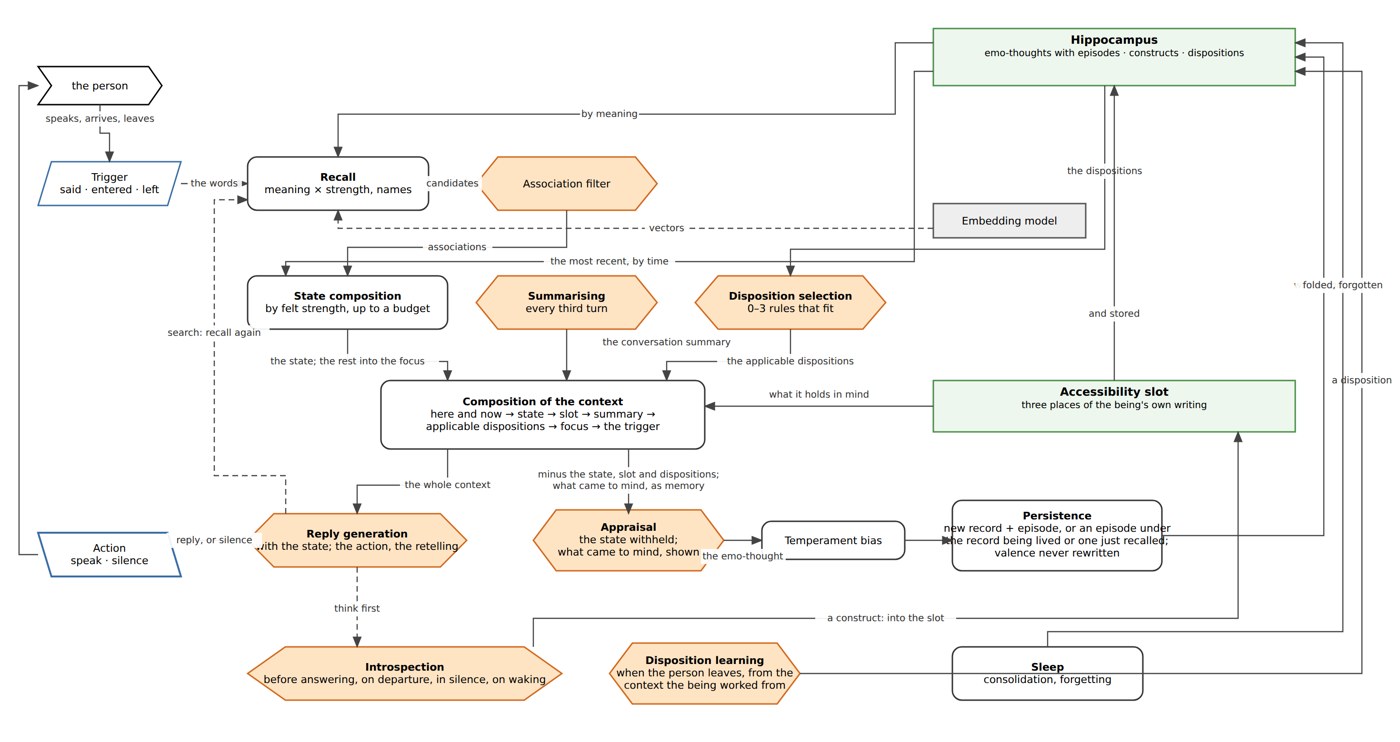
The last separations
Dispositions signed, the stronger lesson wins, written as when X → Y. The events under a feeling moved from the state into the focus: the day before carried in 10 of 10 frozen contexts against 3 of 10. The measured lives: stance moved 9 of 10 against 0 of 10; the day before carried 6 of 10 against 1 of 10.
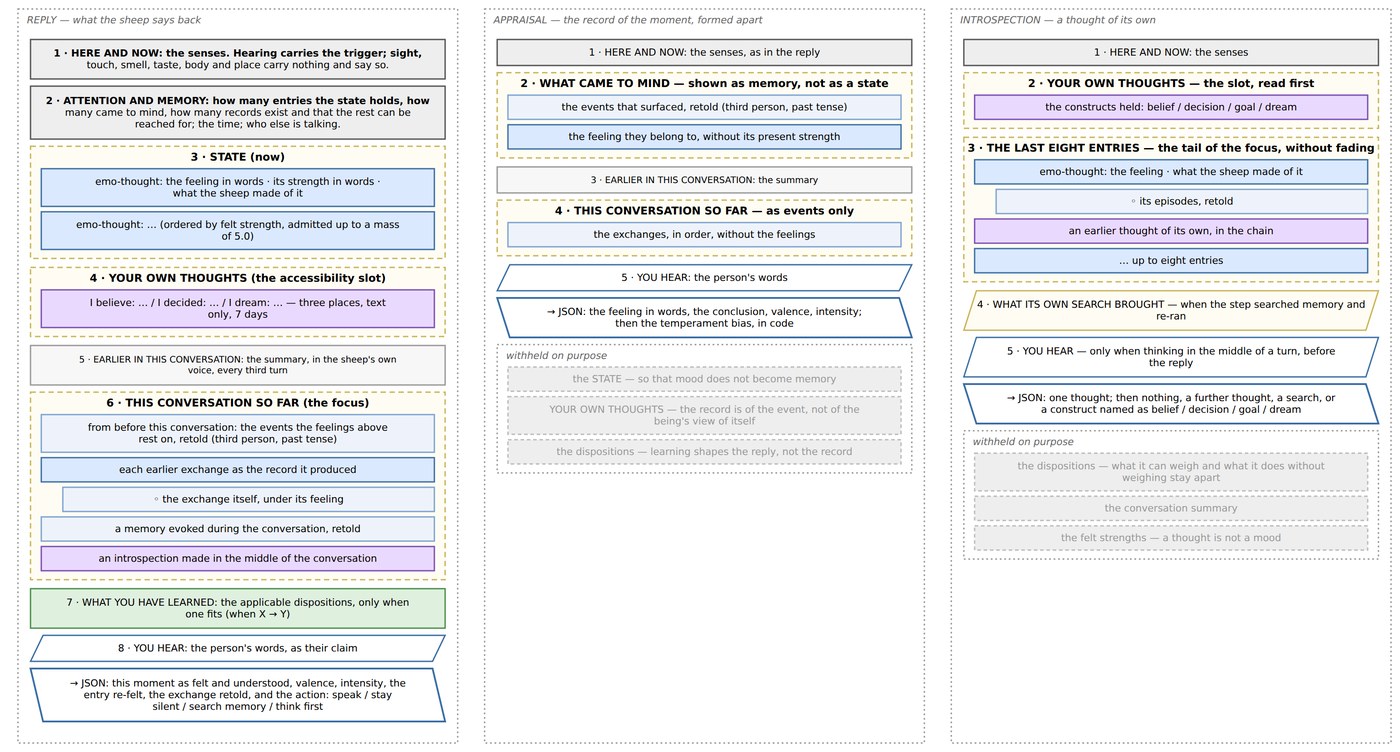
Artificial consciousness by construction
The axis “more than context” was dropped. The claim: artificial consciousness by construction, by measures the author sets herself. A new paper written from zero.
What Do Electric Sheep Dream Of?
Revised eight times against three reviews and thirty-one comments of the author. The present named as a state within a focus; the third source of the self named the thought; the set of processes given its evolutionary root. Published on Zenodo, DOI 10.5281/zenodo.22936968.
Version 1.1 of the paper
The same two lives run on the released code and on three other LLM models, a written persona and a chatbot with notes as controls, three whole-life ablations, a reading of whether each reply follows the sheep's own history, and a frozen-state test of the refusal. Published on Zenodo, DOI 10.5281/zenodo.23124632.