Diagrams of the construction
The figures of the paper What Do Electric Sheep Dream Of?, in one shape grammar, as the engine of the paper is built. Figures 4.1–4.4 are the conceptual model (§4); figures 5.1–5.6 are the implementation (§5). Click a figure to open it at full size.
How to read them
A flag is the person. A parallelogram is a trigger or an input; a reversed parallelogram is an action or an output. A grey rectangle is a component the layer talks to. A coloured rectangle is a record: blue an emo-thought, pale blue an episode, violet a cognitive construct, green a disposition. A double rectangle is the temperament. A rounded box is a process done by code; an orange hexagon is a process done by the processor, in one model call; a diamond is a decision in the code. A green solid frame is a durable container, an amber dashed frame a momentary one; a grey dashed box is where something never reaches. A dashed arrow is an optional path or a further hop.
The conceptual model (§4)
Fig. 4.1 — The elements and their containers
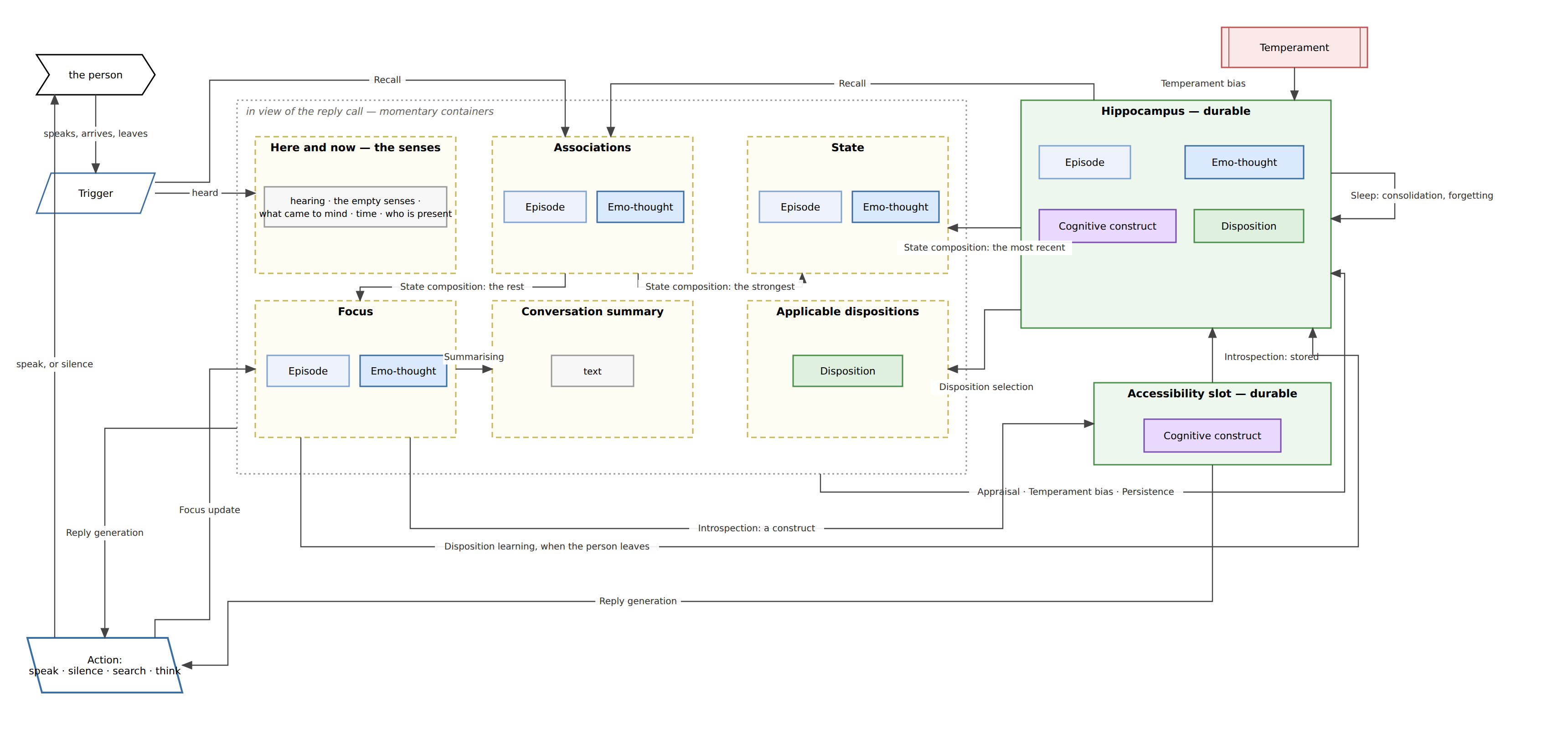
The elements of the conceptual model and where they are in view. Rectangles are records, coloured by kind; a green frame is a durable container, an amber dashed frame a momentary one; the grey frame gathers what the reply call sees. The person, the trigger and the action stand outside the containers. Every arrow carries the name of the process that moves records along it.
Fig. 4.2 — The being in its world
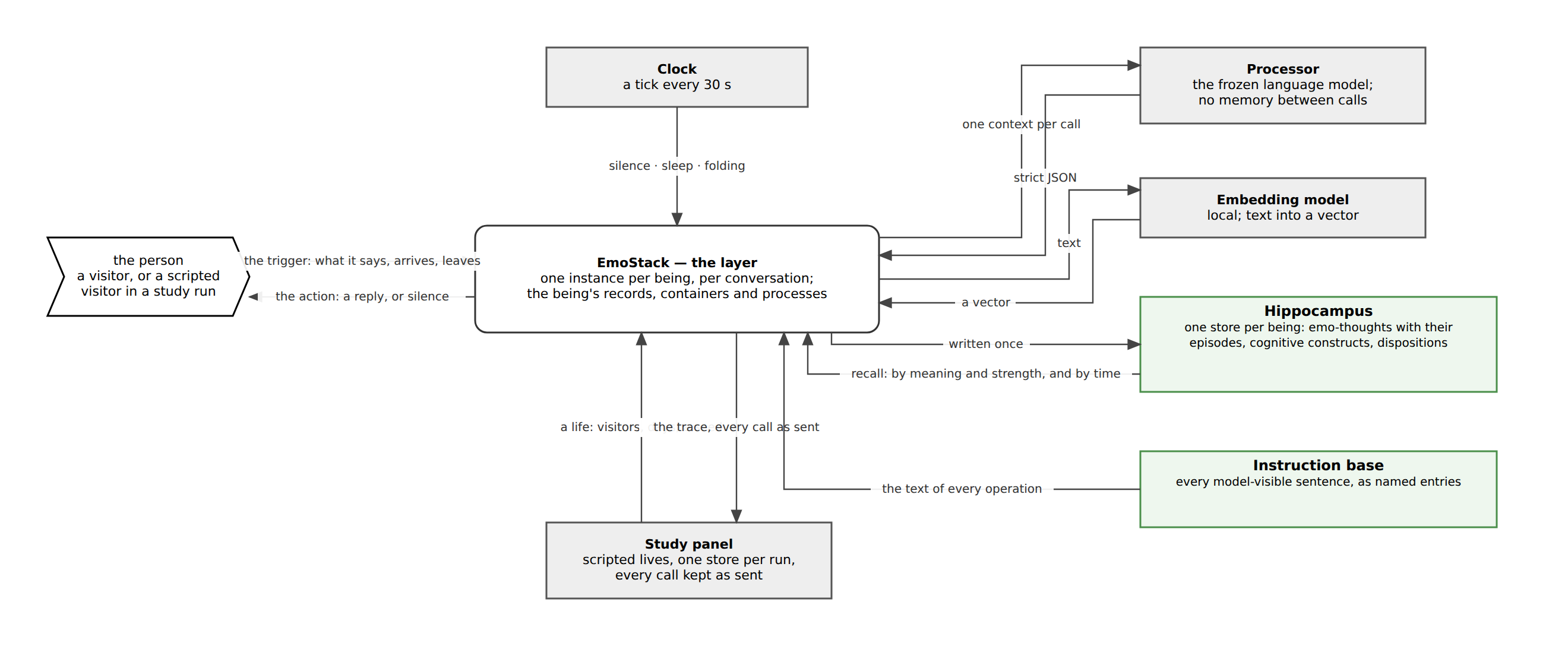
The being in its world: what the layer talks to and what crosses each boundary. The processor holds nothing between calls; the store holds everything; the clock brings silence, sleep and the day's folding; the study panel runs scripted lives and keeps every call as it was sent.
Fig. 4.3 — Between conversations
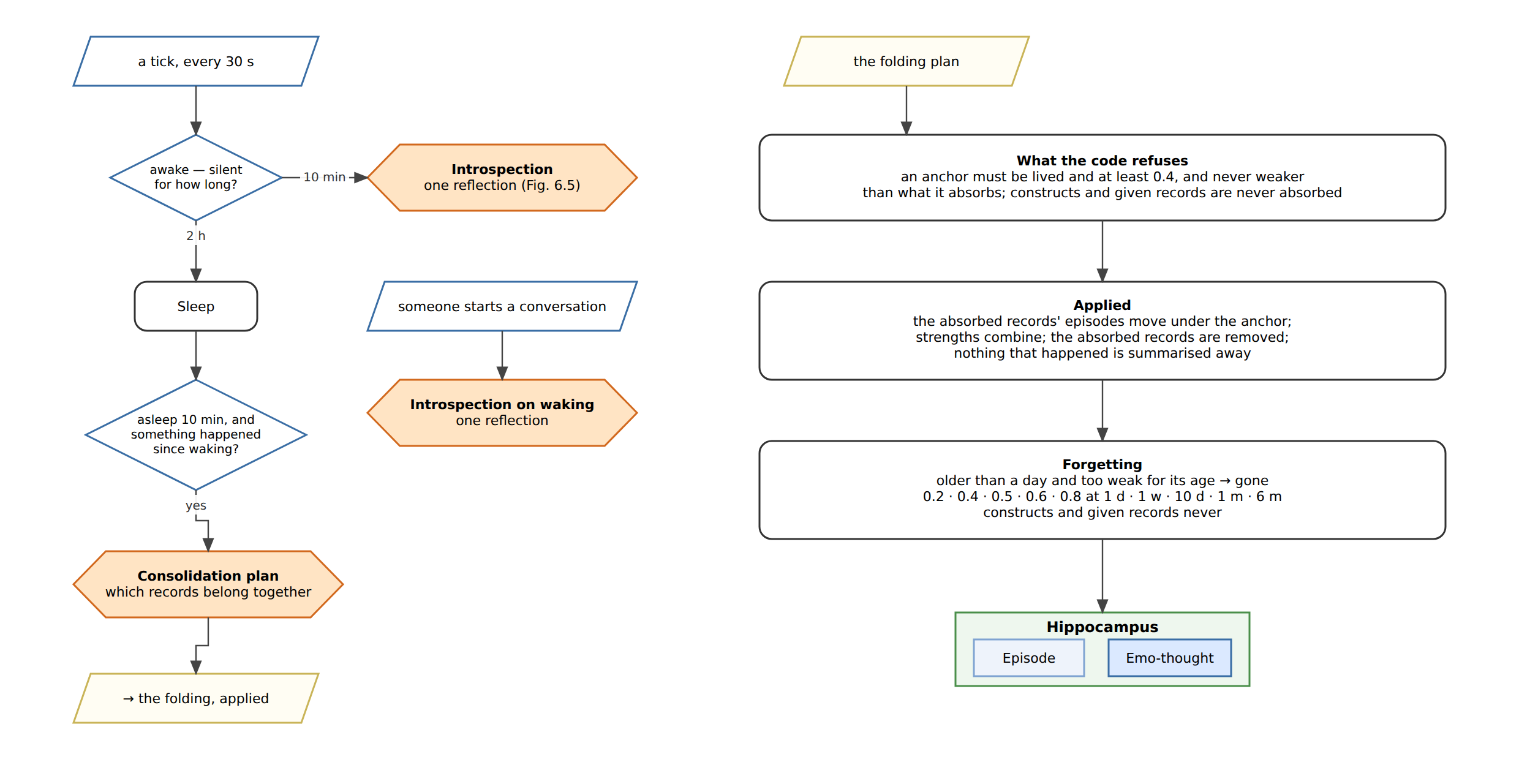
Between conversations: silence leads to a reflection, longer silence to sleep, and sleep to folding and forgetting. The LLM model proposes which records belong together; the code decides what may serve as an anchor and what may never be absorbed or forgotten — seeds and the sheep's own constructs.
Fig. 4.4 — What each call sees
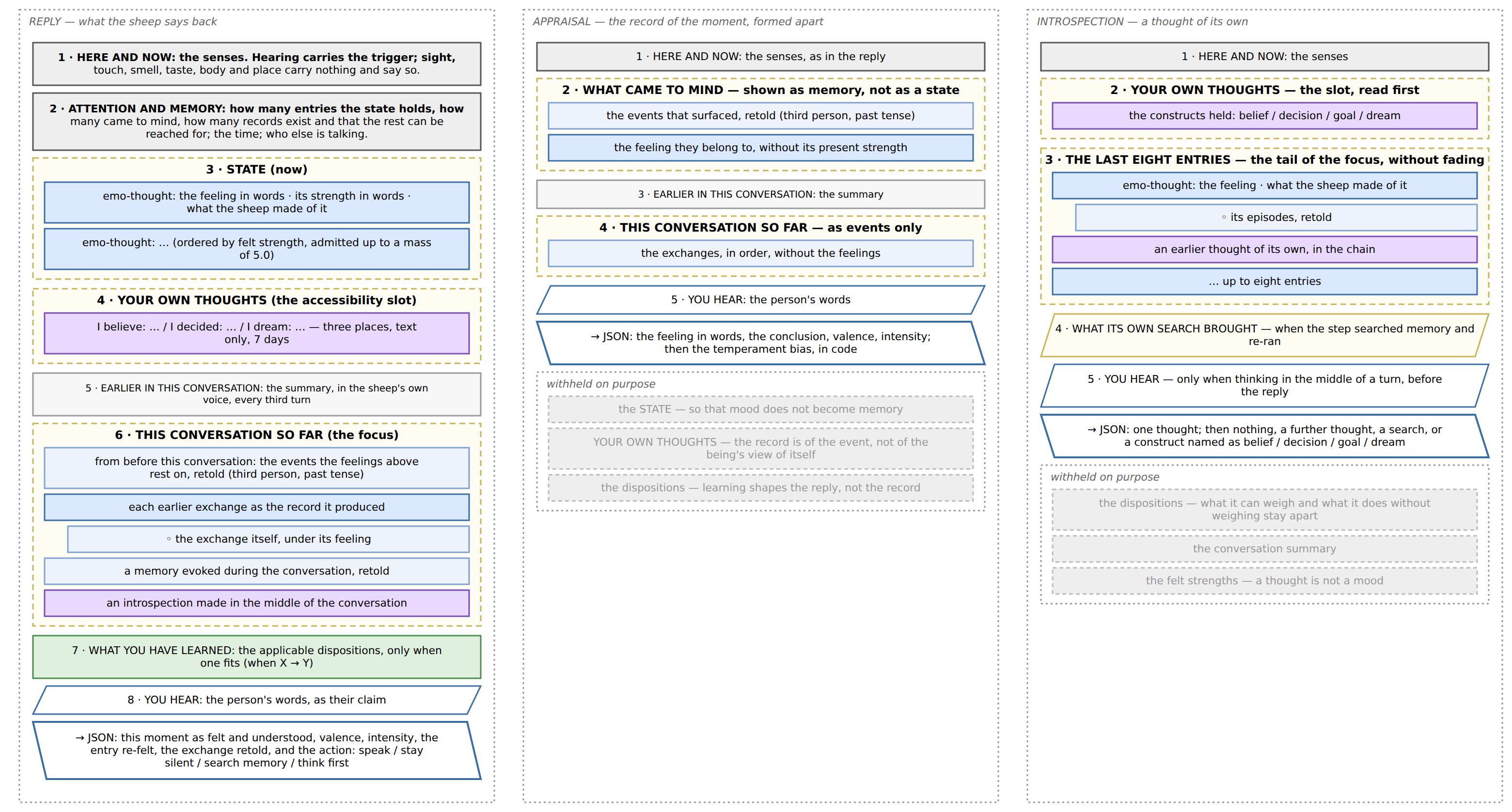
The three contexts. Left, the reply: the senses, the state with its emo-thoughts, the being's own thoughts, the conversation summary, the focus with the events under the feelings, the exchanges as the records they produced and any evoked memory, the applicable dispositions, and what is heard. Middle, the appraisal: the same senses and trigger, what came to mind shown as memory, the summary and the focus as events only; the state, the slot and the dispositions withheld. Right, introspection: the slot first, the last records with their episodes, what its own search brought, the trigger if mid-turn and the previous thought; the dispositions, the summary and the felt strengths withheld.
The implementation (§5)
Fig. 5.1 — The domains of the layer
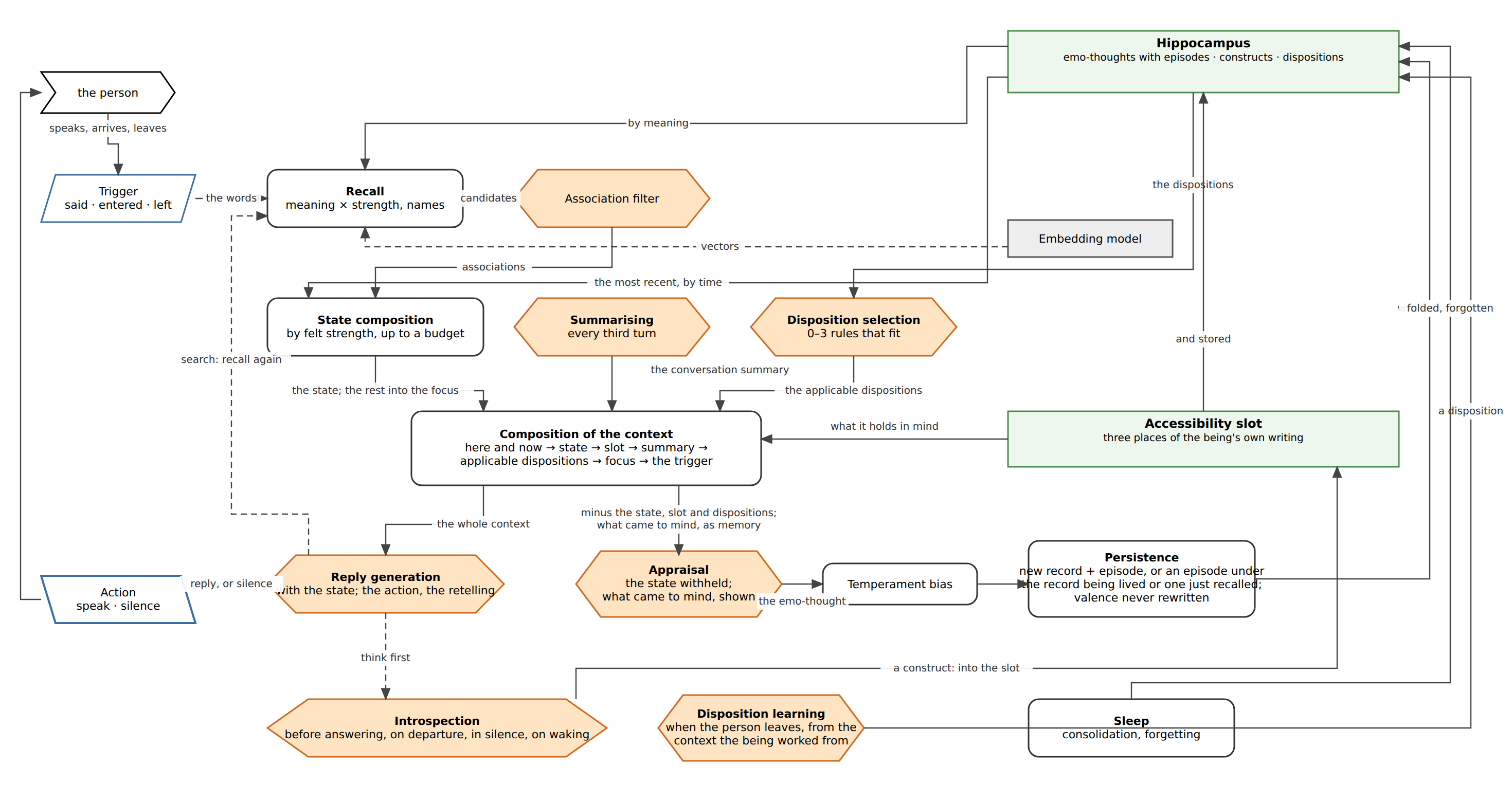
One turn of the layer: the processes of the code, the LLM calls, and the two durable containers they read and write. The person is outside the layer; the hippocampus and the accessibility slot are the only durable things — everything else is rebuilt each turn.
Fig. 5.2 — Recall
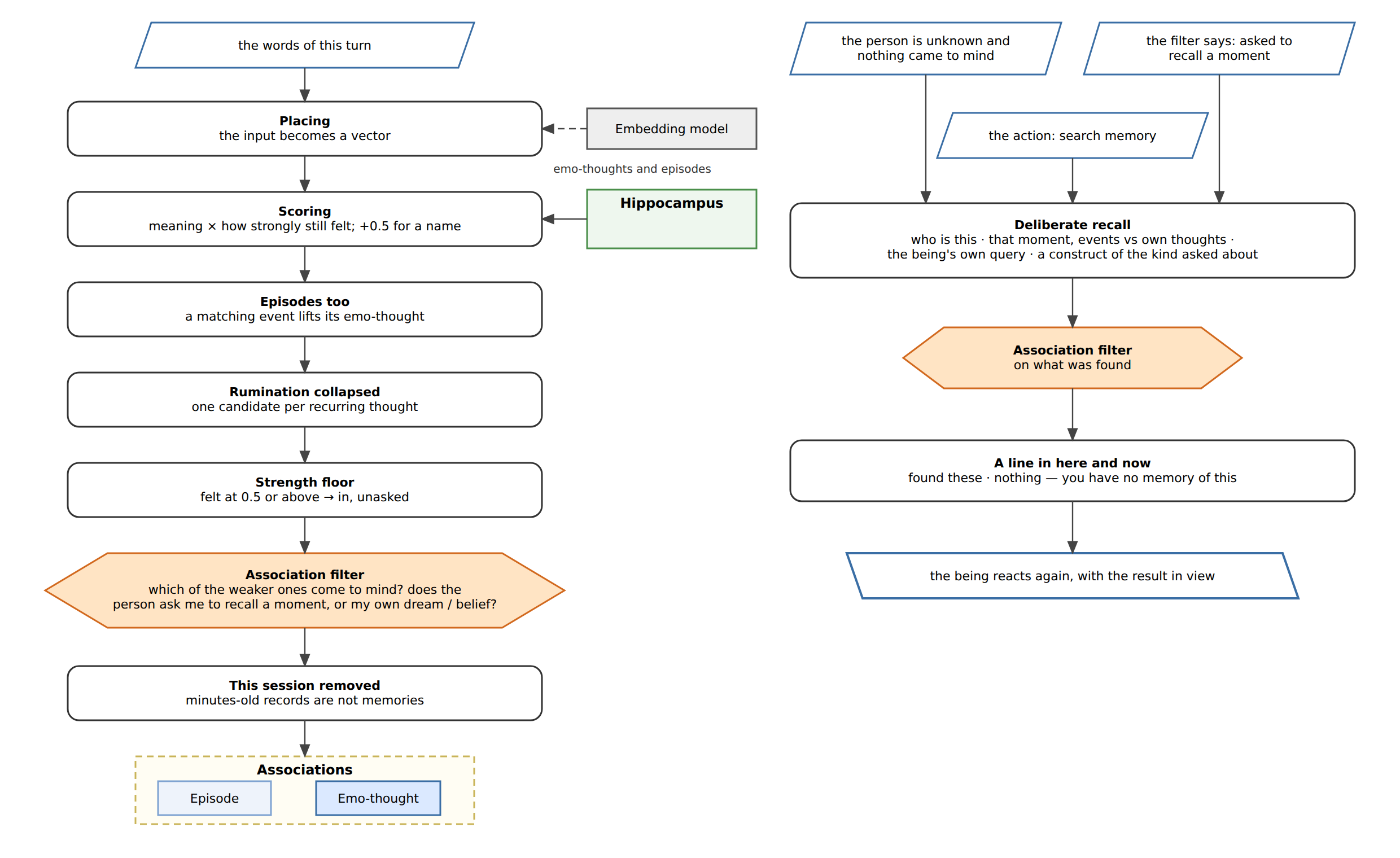
Recall: meaning multiplied by present strength, names lifted, episodes searched alongside emotions, rumination collapsed to one representative, anything still felt at 0.5 admitted without asking, the rest put to the association filter. Below, the three deliberate searches, each ending in a second filter call and a line in the senses — including the spoken null.
Fig. 5.3 — The steps of a turn
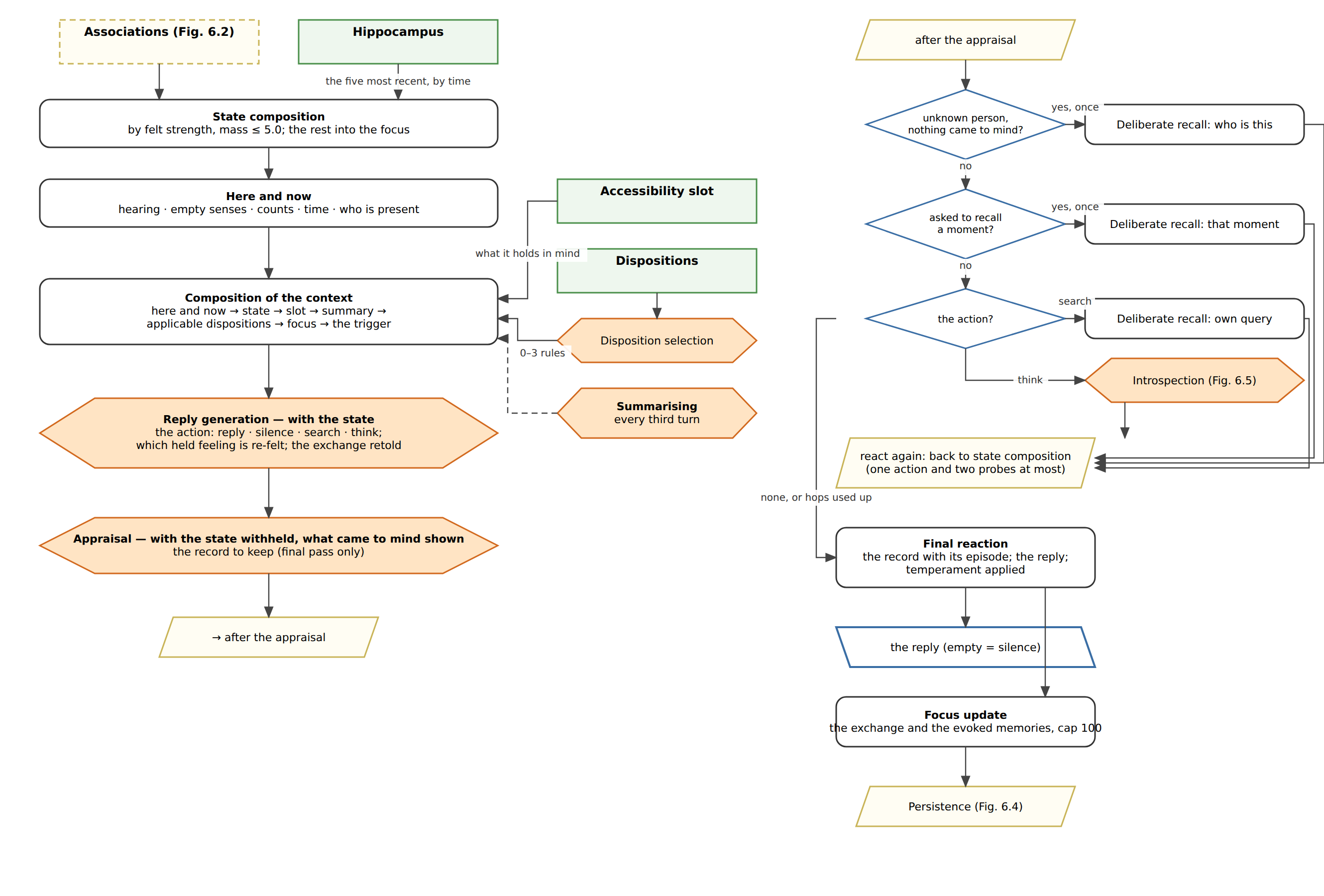
The turn as a loop of calls and hops: state building, the here-and-now block, the reply call, the isolated appraisal, the two probes, the search and think hops that re-run the reaction, and the final reaction that is kept.
Fig. 5.4 — How an exchange becomes a record
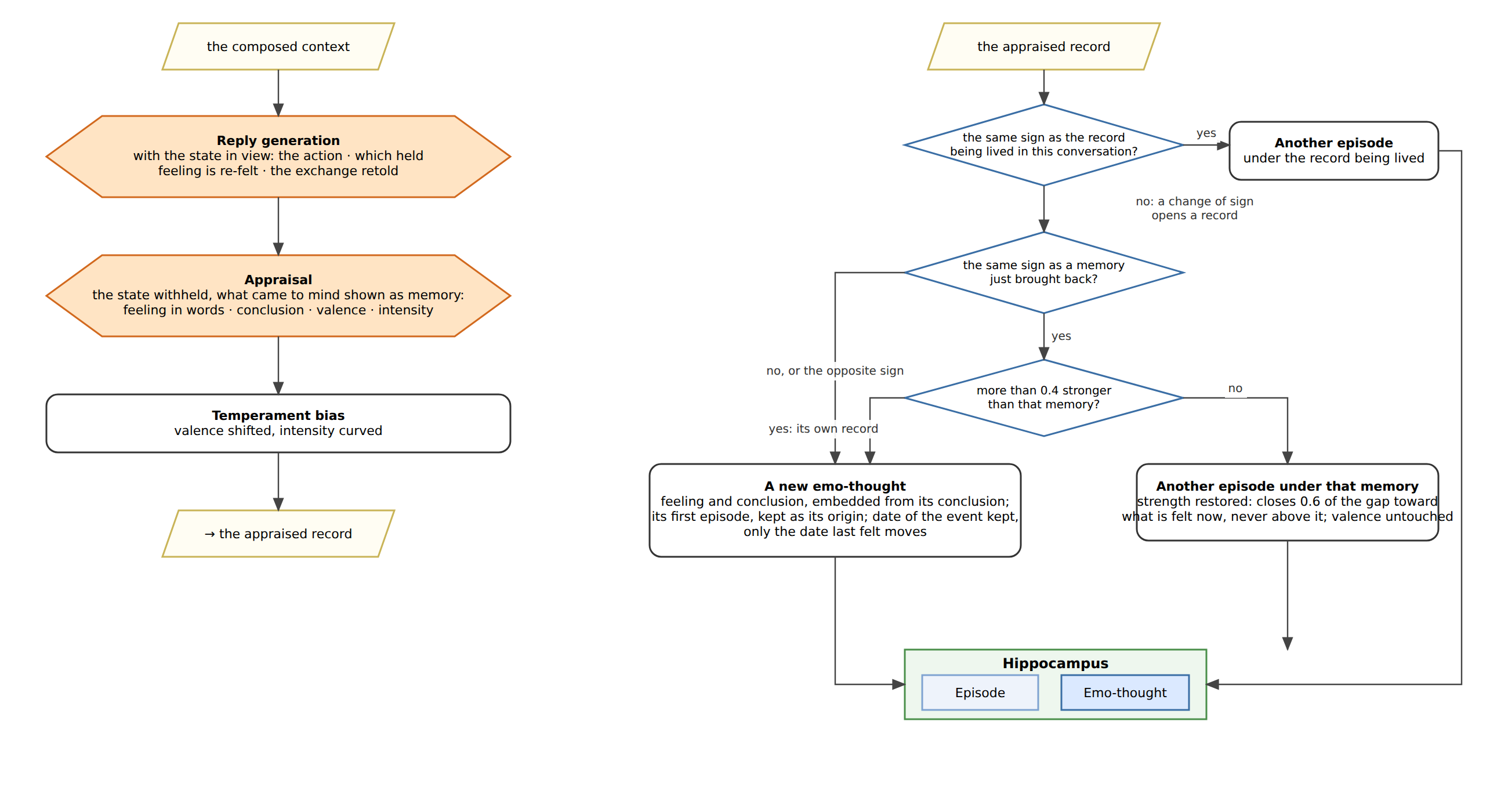
How an exchange becomes a record: the reply call writes the words and the retelling; a second call with the state withheld writes what was felt; temperament bends it; then either a new record is minted or the exchange joins one already held and restores its strength. The moments themselves, and the feeling a record formed with, are never rewritten.
Fig. 5.5 — Introspection
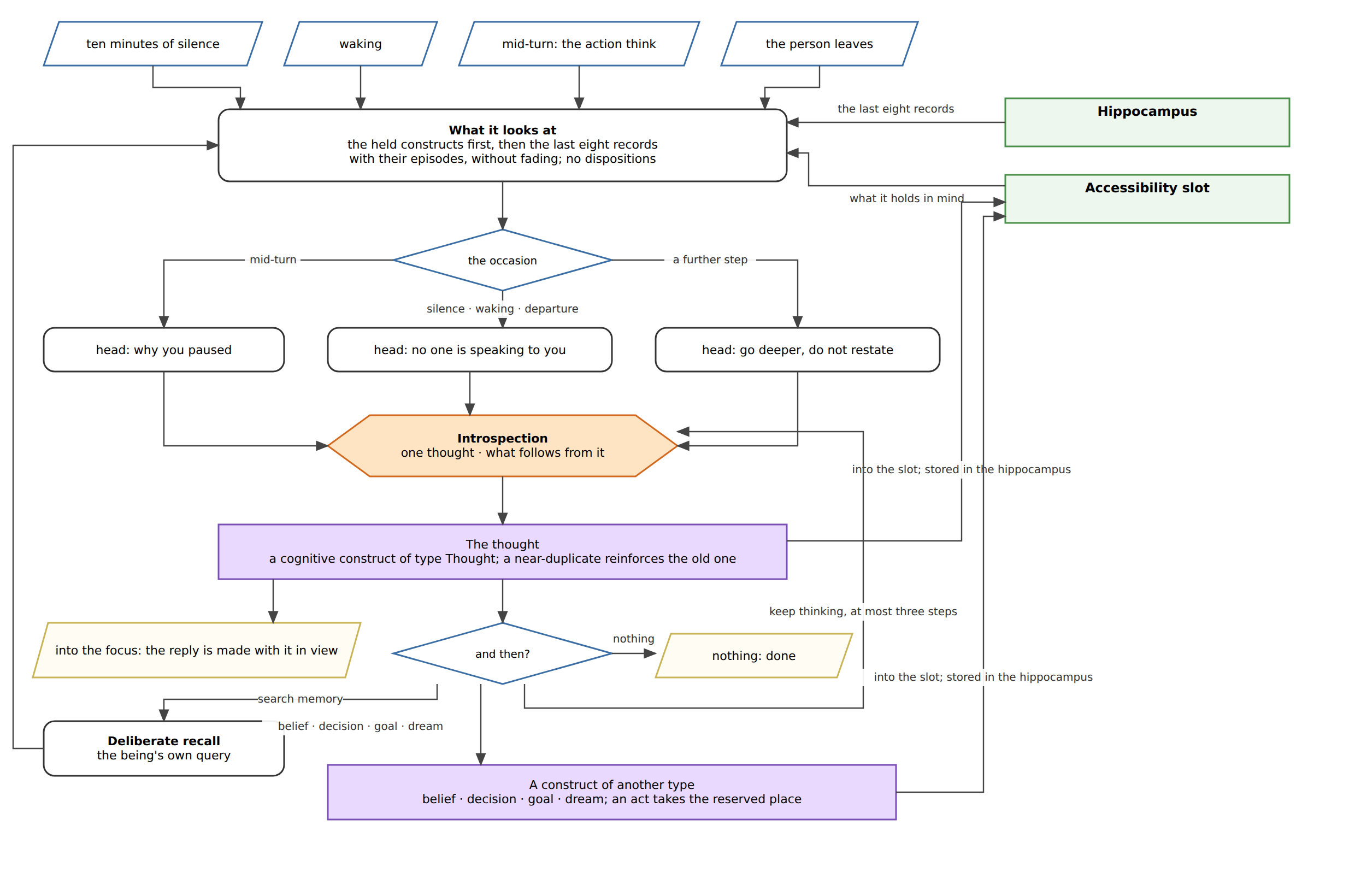
Introspection: the same operation under three occasions — a pause mid-conversation, silence, waking — over eight entries, ending in nothing, a further step, a search, or a construct placed in the slot and the store.
Fig. 5.6 — Learned dispositions
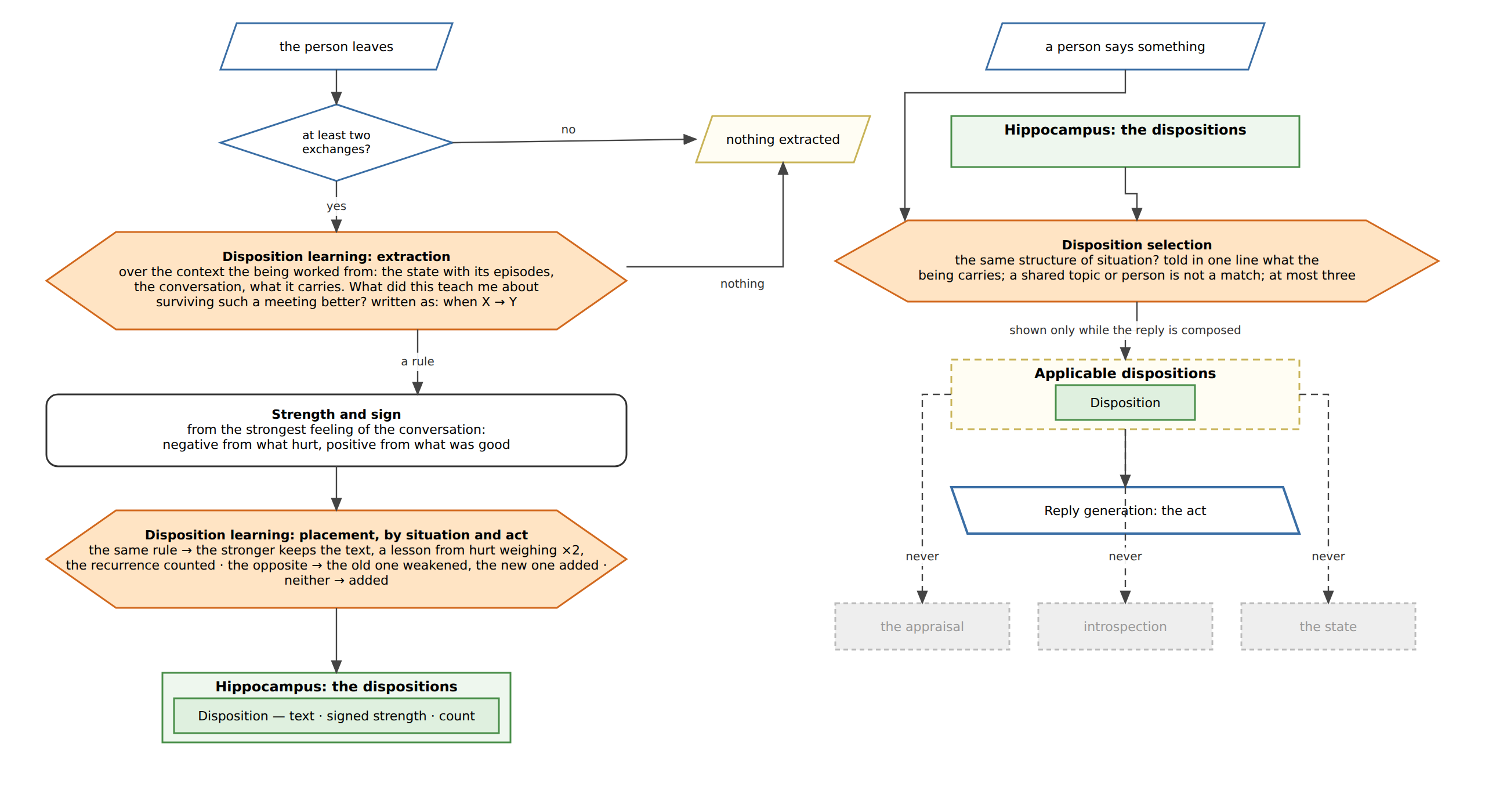
Learned dispositions: the gate of two exchanges, extraction and placement when a conversation closes; selection on the current input; the one place the result is shown, and the three places it never reaches — the appraisal, introspection and the state.